The ubiquitin-proteasome pathway (UPP) regulates intracellular protein quality by clearing dysfunctional or misfolded proteins via the proteasome. The process involves the post-translational modification of proteins with ubiquitin (Ub), where one or more ubiquitin molecules are attached to the lysine side chains of the protein. Ubiquitin serves as a recognition signal for the 26S proteasome. Ubiquitin-modified proteins are transported to the 26S proteasome with the assistance of chaperones, where specialized receptors initiate their degradation.
Transduced from H1299 and HCT116 cells, these cell lines express ubiquitin upon addition of doxycycline. The cell lines constitutively express the repressor protein, which stops the ubiquitin expression. The ubiquitin expression only occurs when the inducer, doxycycline, is added into the culture medium.
Technology
E3 Substrate Discovery
Barroso-Gomila O et al. have developed the BioE3 method, which can be used to label and identify specific substrates of E3 ubiquitin ligases
in vivo. This method utilizes BirA-E3 fusion proteins to perform proximity-based, site-specific ubiquitination.
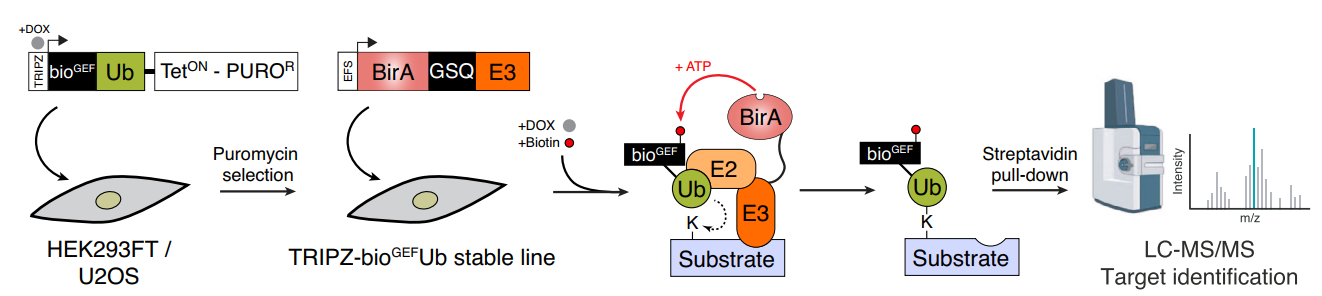
BioE3 employs a version of
AviTag with lower affinity for BirA (called here bio
GEF) fused to a UbL encoding gene. The bio
GEFUb is incorporated into a doxycycline-inducible lentiviral vector for generation of stable cell lines (HEK293FT, U2OS). BirA is fused to the E3 ligase of interest, which is then introduced into bio
GEFUb cells, previously grown in medium with dialyzed, biotin-depleted serum. DOX induction over 24 h leads to production and incorporation of bio
GEFUb into cellular substrates, with concomitant increase in BirA-E3 expression. Finally, exogenous biotin is added, allowing time-limited, proximity-dependent labeling of bio
GEFUb as it is incorporated by the BirA-E3 fusion onto specific substrates. This facilitates streptavidin capture of tagged substrates and identification by LC-MS.
E3 Molecular Glues and PROTACs
- Molecular glue is a type of small molecule that modulates protein–protein interactions in cells by enhancing the affinity between proteins. The glue changes the E3 ligase’s surface, acting as a bridge to physically attract a target protein that would normally not interact with the E3 ligase. Once the target is bound, the E3 ligase marks it with ubiquitin tags. The cell’s proteasome recognizes the tags and shreds the target protein, removing it from the body.
- PROTAC is a heterodimeric molecule with two active domains and a linker, consisting of two covalently linked protein-binding molecules: one binds to an E3 ubiquitin ligase, while the other binds to the target protein. Recruiting the E3 ubiquitin ligase to the target protein leads to its ubiquitination and subsequent degradation by the proteasome.
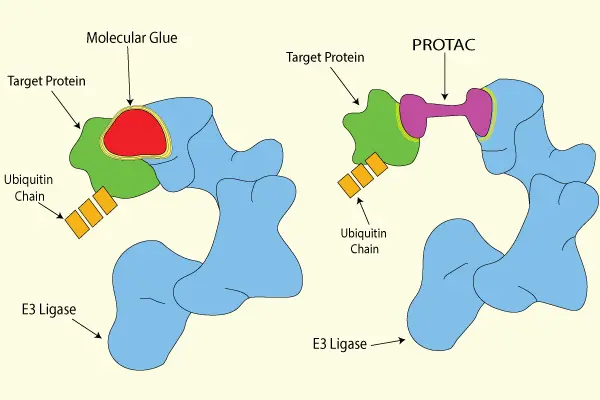
Fig. Schematic showing differences in the mechanism by which molecular glues interact with substrate to promote E3-ligase interaction versus PROTACs use of heterobifunctional molecules that recruit substrate and E3-ligases and tether them together.
