
Targeted protein degradation
Targeted protein degradation (TPD) is an emerging therapeutic strategy that leverages the cell’s native degradation machinery to eliminate disease-causing proteins. An advanced approach in this field operates by mediating proximity-induced ubiquitination between E3 ubiquitin ligases and proteins of interest, thereby triggering their proteasomal destruction. Recent advances have expanded this paradigm to cell-surface proteins, opening a new frontier in targeting the undrugged proteome.
Of the over 680 known E3 ubiquitin ligases, only a dozen or so to date have been employed for this approach. There is a clear need to identify additional E3 ligases that can be harnessed for TPD, to accommodate a broad range of therapeutically relevant targets with differential localization and expression.
Systematic Study of E3 Ubiquitin Ligases
E3 ubiquitin ligases are key components of the ubiquitin–proteasome system, selecting and tagging target proteins for degradation or regulation. With over 600 members, they control vital processes such as cell cycle, DNA repair, and immune signaling. Dysregulated E3 activity drives cancer, neurodegeneration, and inflammation, making E3s important targets for mechanistic studies and drug development.
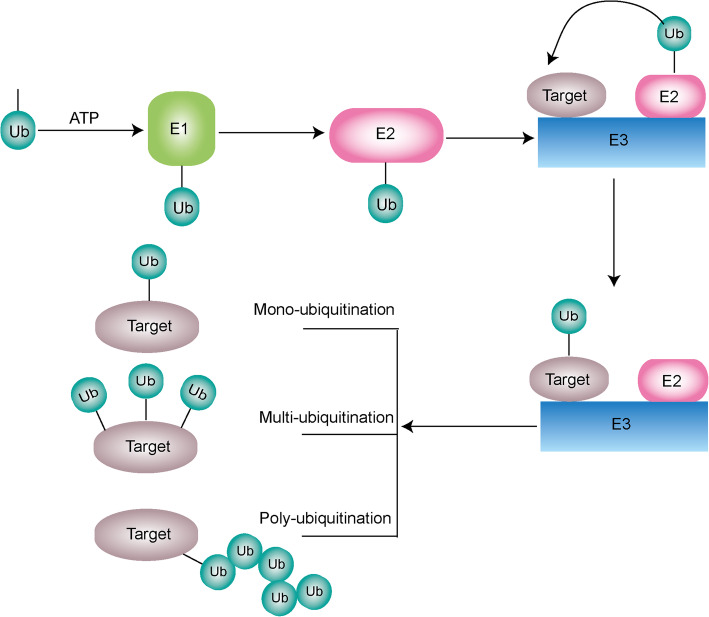
Fig. Overview of the cascade process of ubiquitination.
GeneCopoeia offers a complete workflow for systematic E3 ligase studies—covering expression profiling, promoter/UTR regulation, CRISPR editing, ORF overexpression, and custom cell line generation—enabling researchers to quickly access all products and services needed for E3 functional analysis.
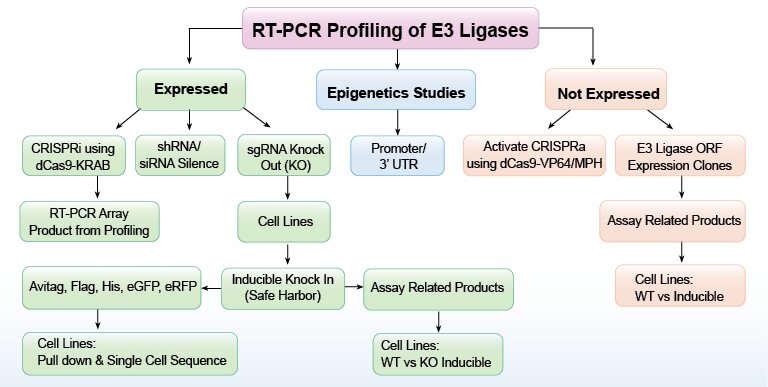
Fig. Systematic study of E3 ubiquitin ligases
Loss of function
Loss-of-function studies
Click on the cube to visit the product detail page

 |
E3 ubiquitin ligases ORF expression clone set |

 |
shRNA clone sets against E3 ubiquitin ligases: a shRNA package containing 3 individual shRNA constructs and a scrambled control |

 |
sgRNA targeting E3 ubiquitin ligases |

 |
Mammalian cell lines stably expressing dCas9-KRAB fusion protein for the study of transcriptional inhibition of endogenous genes |

 |
Designed for profiling the expressions of pre-made or customized sets of coding-genes in various tissues or cells |

Gain of function
Gain-of-function studies
Click on the cube to visit the product detail page
 |
Mammalian cell lines stably expressing synergistic activation mediators (SAM) for the study of transcriptional activation of endogenous genes |
 |
E3 ubiquitin ligases ORF expression clone set |
Epigenetics
Epigenetics studies
Click on the cube to visit the product detail page
 |
Using secretable GLuc as the reporter gene, GLuc-ON™ promoter clones enable promoter activity detection in live-cell assays, offering both single-reporter and dual-reporter vector systems |
 |
Used for miRNA target identification and functional validation of predicted targets, or to study the regulatory effect of miRNAs on target genes |


