High-Resolution Epitope Mapping & Discovery Services |
 |
Request a quote! |
Overview
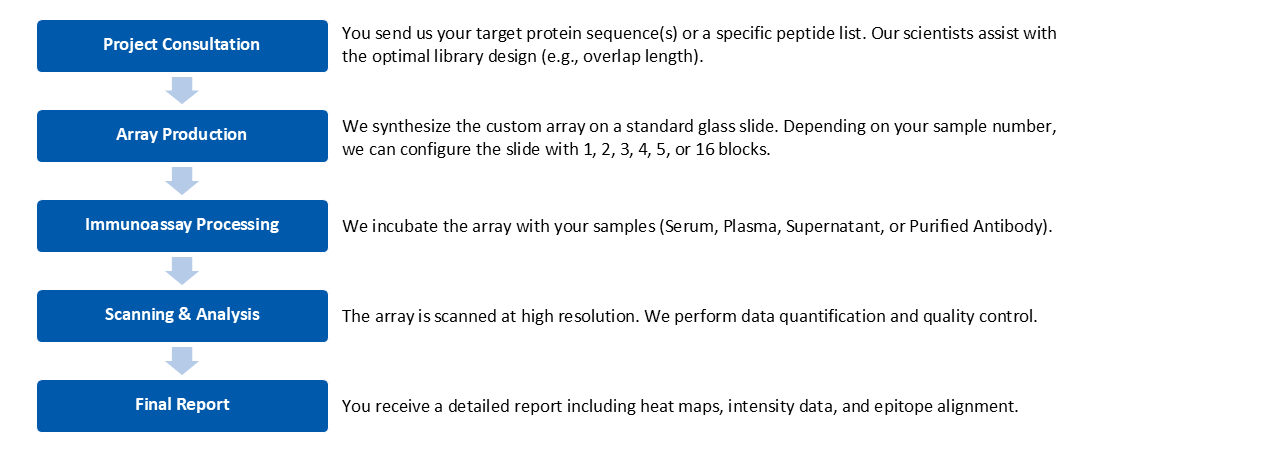
The OmicsArray™ Custom Peptide Array Service provides a fully tailored solution for researchers needing high-resolution epitope mapping, antibody profiling, and biomarker discovery. Powered by PEPperPRINT® Laser Printing Technology, we synthesize custom peptide libraries directly on the chip surface. This “on-chip” synthesis allows for maximum flexibility and density, enabling us to print highly overlapping peptide libraries (e.g., shifting by just 1 amino acid) to map epitopes with single-residue precision. This is a Full-Service Solution: You provide the protein sequence or peptide list and your biological samples. Our team handles the entire workflow—library design, array synthesis, sample processing, scanning, and bioinformatics analysis.Why Choose OmicsArray™ Custom Peptide Array Service?
- Maximal Resolution: We typically use a “Shift of 1” design (15-mer peptides overlapping by 14 amino acids). This ensures that no binding motif is missed and allows for precise identification of essential binding residues.
- Flexible Multiplexing (1 to 16 Blocks): Our standard slides can be printed as a single large array or divided into up to 16 individual blocks (sub-arrays). This allows you to screen multiple samples (up to 16) simultaneously on a single slide, maximizing cost-efficiency.
- Cost-Effective Customization: Because we use digital laser printing, there are no expensive setup costs for masks or pre-synthesis of peptides.
- Minimal Sample Required: We can generate high-quality data from as little as 20 µL of serum or plasma
Service Applications
Service Applications
We offer several custom design formats to suit your specific research goals.
- Linear Epitope Mapping The gold standard for defining antibody binding sites.
- Method: We translate your target protein sequence into overlapping linear peptides.
- Typical Design: 15 amino acid length with a 14 amino acid overlap (1 aa shift).
- Goal: Pinpoint the exact linear sequence where your antibody or serum binds.
- Conformational Epitope Mapping (Cyclic Peptides)
- mimic protein loops and 3D structures.*
- Method: We synthesize peptides with cyclic constraints (e.g., disulfide bridges) directly on the array.
- Typical Design: Loops of 7, 10, or 13 amino acids.
- Goal: Identify antibodies that recognize 3D structural features rather than just linear sequences.
- Substitution Scans (“Alanine Scanning”) Identify critical residues for binding affinity.
- Method: Systematically substitute every amino acid in a known wild-type epitope with Alanine (or other amino acids).
- Goal: Determine which specific amino acids are essential for the antibody-antigen interaction.
- Discovery Screening For unbiased discovery.
- Method: Screen randomized libraries or combinatorial lists.
- Goal: Discover novel mimotopes or signature biomarkers from complex samples.