Select Page

Protein expression

Answer: You can choose any desired tag for your target protein, as well as decide whether you want the tag to be placed at the N- or C-terminus. You may also use a GeneCopoeia expression construct or provide your own expression clone.

We strongly recommend using a GeneCopoeia OmicsLink™ Expression-Ready ORF clone, which can come with many different tags from which to choose. Our ORFs can be fused with virtually all of the commonly used, powerful tags designed for any application, such as His, eGFP, eYFP, mCherry, Avi, 3xHA, Flag, HaloTag®, etc. In addition, you can choose either fusion expression or non-fusion expression via an Internal ribosome entry site (IRES) or 2A element, which permit protein co-expression, so that you can monitor precise gene expression. With an IRES or 2A element, you can monitor the accurate expression of a native protein without any potentially negative effects caused by fusion tags.

Answer: We offer pre-made recombinant protein products. Our expression facility uses host cell systems such as bacteria, mammalian cell lines (typically HEK293T cells), yeast, insect and cell-free expression systems. With fully sequence-verified expression clones from GeneCopoeia, we help researchers save time for further research.
Answer: GeneCopoeia provides pre-made recombinant proteins in standard amounts of either 25 µg or 100µg. You may also request custom amounts. Please contact technical support to get more information.
Answer: The concentration of GeneCopoeia recombinant protein is determined using the BCA assay.
Answer: Yes. GeneCopoeia recombinant proteins are produced serum-free. In addition, most of GeneCopoeia’s proteins are carrier-free (except for proteinase products). They do not contain BSA, and therefore can be used directly in SDS PAGE gels and western blots.
Answer: Yes. Removing a tag can be as easy as choosing one. The removal of some small molecular weight tags, such as His and Flag, is often not necessary.
Answer: GeneCopoeia uses either affinity purification or ion exchange chromatography for protein purification. We will determine the best purification strategy based on your needs and the protein’s properties.
Answer: GeneCopoeia recombinant proteins have not been functionally tested in vivo. Therefore, GeneCopoeia cannot guarantee that all proteins are fully functional in all assays, including those for in vivo applications.
Answer: GeneCopoeia recombinant proteins generally remain stable for 1-3 years under appropriate storage conditions. We recommend aliquotting the protein solution and storing the tubes at -80℃. Avoid repeated freeze-thaw cycles.

Fast-Fusion™ Cloning Kit

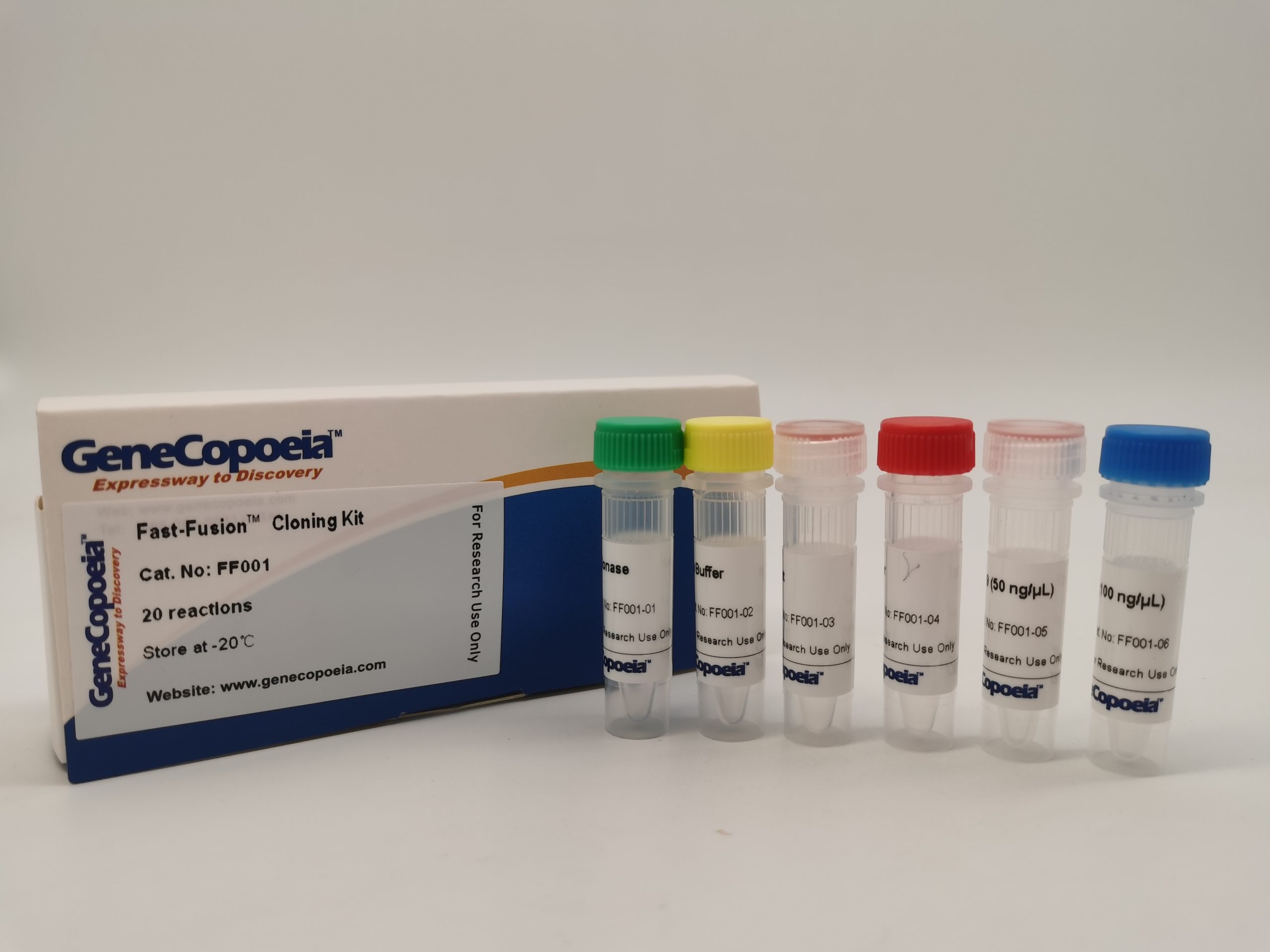
Fast-Fusion™ Cloning Kit (20 reactions)
Fast-Fusion™ Cloning Kit  (60 reactions)
Fast-Fusion™ Cloning Kit (60 reactions)

Fast-Fusion™ Cloning Kit (20 reactions) Fast-Fusion™ Cloning Kit (60 reactions)

Price: $352.00 $806.00
Catalog#:
  • FF001
  • FF002
Size: 20 reactions 60 reactions
Qty:
Manual: DownloadDownload
View your cart


Introduction

For rapid and effective cloning of PCR products

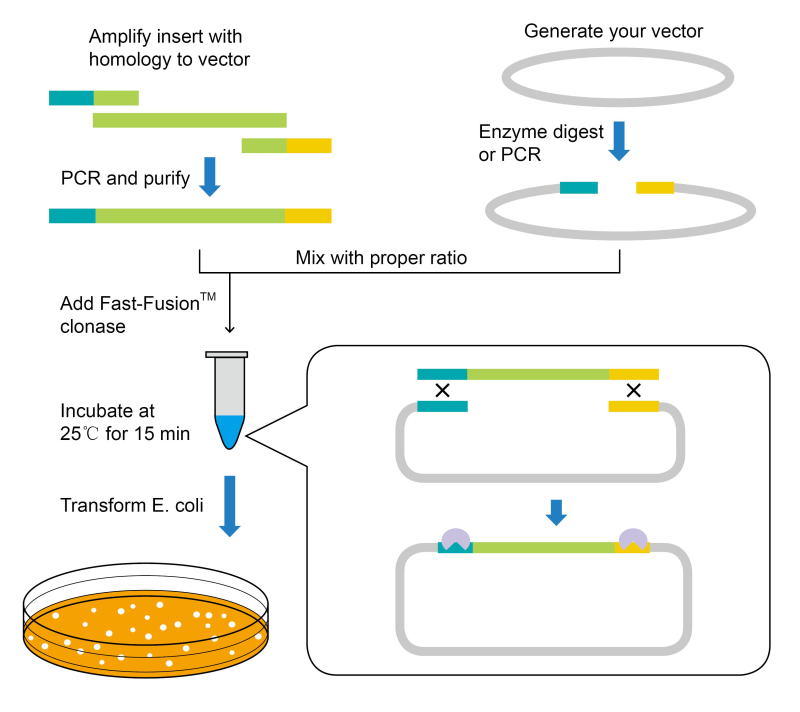
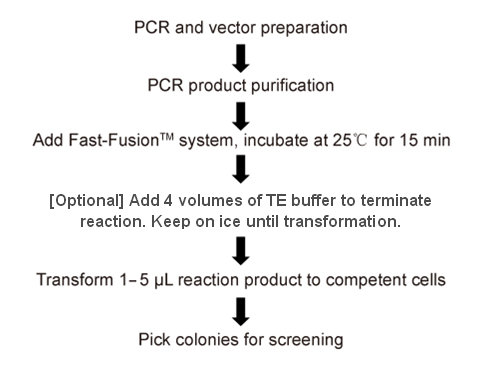
Fast-Fusion™ Cloning Kit provides a rapid method for cloning your PCR product. In just 15 minutes at room temperature, any PCR fragment can be cloned into your linearized vector at will. After a simple clean up step, a PCR-generated DNA fragment or other purified DNA fragment can be joined to a vector with overlapping ends (Fig.1). Up to eight DNA fragments can be joined together in a single reaction. Well-prepared vectors generate almost 100% positive clones. There is no restriction site required at the junction site. Therefore, your fragment of interest can be inserted at any position in the vector. The linearized vector can be generated by either PCR or restriction enzyme digestion. The PCR products can be produced by either Taq DNA polymerase or other high fidelity DNA polymerase.

Advantages

Fast and simple

  • 1 minute for operation and 15 minutes for incubation at room temperature.

High adaptability

  • No restriction site or recombination site needed, insert fragments generated by either PCR or restriction enzyme digestion can be used.

Seamless construction

  • Final constructs have no extra base pairs remaining.

Flexibility

  • Multiple inserts can be assembled in one reaction. Suitable for multi-site mutagenesis.

High efficiency

  • Greater than 90% of colonies after transformation contain the correct insert(s).


Portocol overview
CP-C9NU-01

CP-C9NU-01

Figure 1. Experimental workflow of single fragment insertion into a vector using the GeneCopoeia Fast-Fusion™ Cloning Kit

Example
CP-C9NU-01

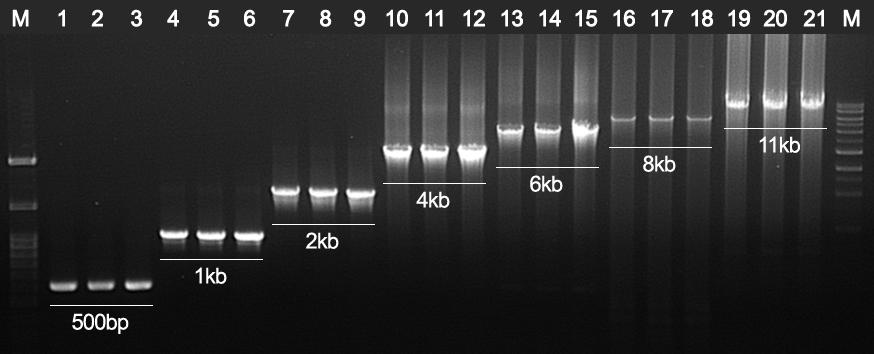
Figure 2. PCR screening results. Lane1-3: 500 bp, lane 4-6: 1 kb, lane 7-9: 2 kb, lane 10-12: 4 kb, lane 13-15: 6 kb, lane 16-18: 8 kb, lane 19-21: 11 kb. Seven DNA fragments of different lengths were cloned into same vector respectively by Fast-Fusion Cloning Kit. Colonies were selected randomly for PCR screening after transformation. The results showed that all reactions gave high efficiency.