by admin | Oct 23, 2013 | Products
– To validate ORF cDNA expression, shRNA knockdown, miRNA target or promoter activity
GeneCopoeia provides cell-based validation services to help researchers to validate the function and performance of expression clones using standard cell lines or customer’s own cell lines.
No matter you are studying transgene overexpression (ORF cDNA clones), gene knockdown (shRNA clones), transcription regulation in the promoter region (promoter reporter clones), or translation regulation by microRNA (microRNA target clones), GeneCopoeia’s expression clone collections and cell-based validation services are powerful tools to support your functional genomic research.
GeneCopoeia’s cell-based validation services cover ORF cDNA clone expression validation, shRNA knockdown validation, miRNA target validation and promoter activity validation.
Advantages |
 |
- Largest clone collections to best suit your needs
- Strict and rigorous experiment protocol to ensure quality results
- Detailed reports and datasheets to assist decision making
- Complete services to support your research needs
|
GeneCopoeia’s cell-based validation services include:
ORF cDNA clone expression validation |
shRNA knockdown validation |
miRNA target validation |
Promoter activity validation |
| Detect recombinant protein expression in mammalian cells or bacteria using western blot. |
Measure the efficiency of shRNA knockdown of GOI on the messenger-RNA level using qRT-PCR. |
Validate the inhibitory effect of a particular miRNA on the 3’UTR region of GOI using luciferase reporter assays. |
Detect exogenous promoter activation in mammalian cells using luciferase reporter assays. |
Examples
ORF
Method:
Western Blot
|
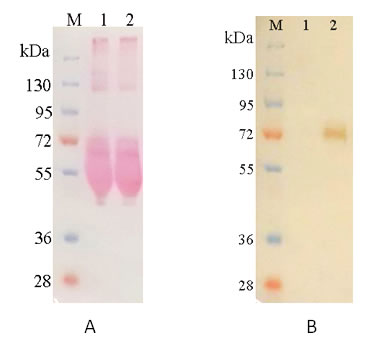
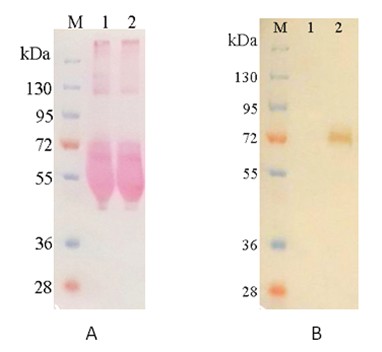
| Figure 1. Secreted TPP1 recombinant protein expression in 293 cells.TPP1 protein was secreted into the culture medium 48hrs after transient transfection with TPP1 expression clone (Z5873). The culture media (15uL per lane) were collected, resolved using10% SDS-PAGE/Tris-Glycine, transferred to a NC membrane, and probed with the anti-Flag antibody (CGAB-DDK-0050). A) The NC membrane was stained with Ponceau S. B) The western blot results were visualized with a chromogenic substrate. The culture medium of HEK293T cells without transfection was used as the negative control (lane 1). |
shRNA
Method: qRT-PCR
|
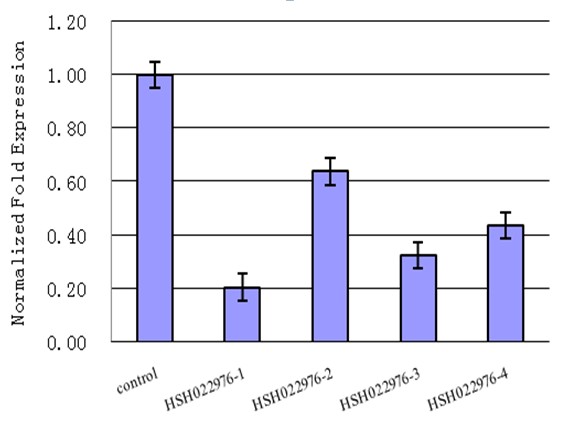
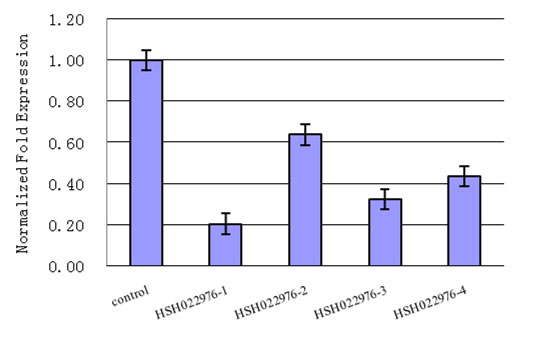
| Figure 2. CD44 knocked down by 4 different shRNAs in HEK 293Ta cells. The HEK 293Ta cells were transfected with 1) shRNA scrambled control, 2) shRNA-1 (HSH022976-1-nH1), 3) shRNA-2 (HSH022976-2-nH1), 4) shRNA-3 (HSH022976-3-nH1), and 5) shRNA-4 (HSH022976-4-nH1), respectively. Total RNAs were extracted from each sample and quantified by qRT-PCR using CD44 specific primers. GAPDH(NM_002046)expression was also quantified and used for normalization. The normalized CD44 expression was set to 1 for the scrambled control transfected sample (first left bar). The results show that the shRNAs knocked down the CD44 mRNA expression level by 79% (HSH022976-1), 36% (HSH022976-2), 68% (HSH022976-3), and 56% (HSH022976-4) respectively. |
miRNA
Method:
Luciferase Reporter Assays
|
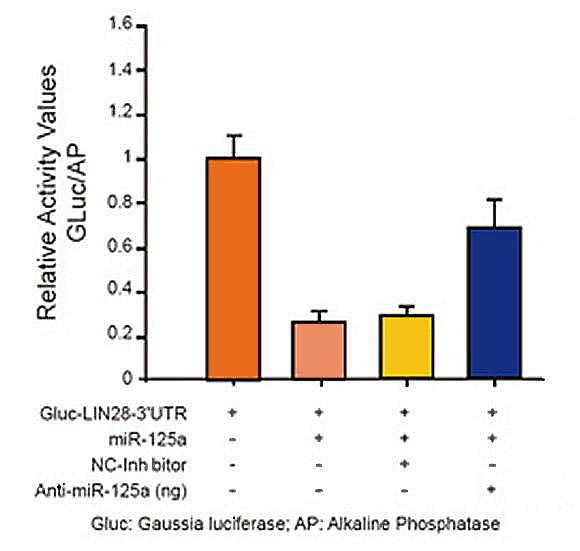
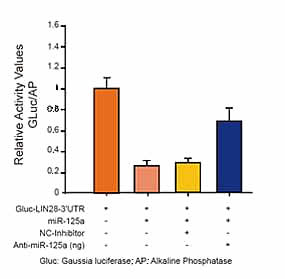
| Figure 3. The suppression effect of miR-125a on LIN28 3’UTR target reporter expression in HEK 293 cells. LIN28 is the known target gene for miR-125a. A LIN28 3’UTR target sequence expression clone (HmiT019205-MT05) was transfected into HEK 293 cells 1) alone 2) with miR-125a miRNA precursor expression clone (HmiR0309-MR03) 3) with miR-125a miRNA precursor expression clone and miRNA inhibitor scrambled control clone (CmiR-AN0001-AM03) 4) with miR-125a miRNA precursor expression clone and miR-125a miRNA inhibitor clone (HmiR-AN0094-AM01). Both the Gaussia luciferase (GLuc) activity and an internal control Alkaline Phosphatase (AP) activity were determined 24 hours post-transfection. The activity ratio of GLuc to AP was set to 1 for the single transfection sample with LIN28 3′-UTR target sequence expression clone (left-most bar), against which the activities of other samples were normalized. The result shows that mir-125a suppressed the luciferase activity from the Gluc-LIN28-3′-UTR clone by more than 70% (Bar 2 from left). This suppression effect was blocked by the introduction of miArrest™ inhibitor clone against miR-125a (right-most bar) . |
Promoter
Method:
Luciferase Reporter Assays
|
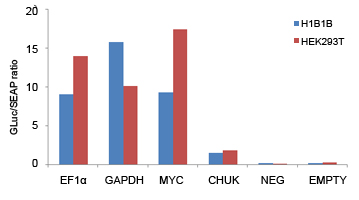
| Figure 4: Normalized promoter activities in H1B1B and HEK293T cells. Dual-reporter promoter clones or controls were transfected into two cell lines in duplicates. Samples were analyzed 24 hrs (HEK293T) and 48 hrs (H1B1B) after transfection. NEG (containing non-promoter sequence) and EMPTY (no promoter in the vector) are negative controls. |
Request a Quote
To request a quote for a cell-based validation service, please fill out the inquiry form here.
Related Services
Lentivirus packaging services
Delivering high titer lentivirus in either purified form.
Stable cell line development services
For stable cell-line development, gene amplification, single clone selection, cell line characterization and more.
by admin | Oct 12, 2013 | Genome editing tools
Genome Editing is revolutionizing biomedical research, due to its high efficiency, ease-of-use, and relatively low cost. With products for CRISPR-Cas9 clones, validation and screening kits, pre-made stable cell lines, and more, GeneCopoeia’s Complete Solutions for Genome Editing provide you with a wealth of tools to help you every step of the way in your genome editing workflow.
 |
CRISPR products & services |
|
 |
HDR donors |
|
|
TALEN &TALE-TF clones |
|
|
Safe harbor products |
|
 |
Cell-based validation
& screening |
|