











Premade antigen microarray
Introduction
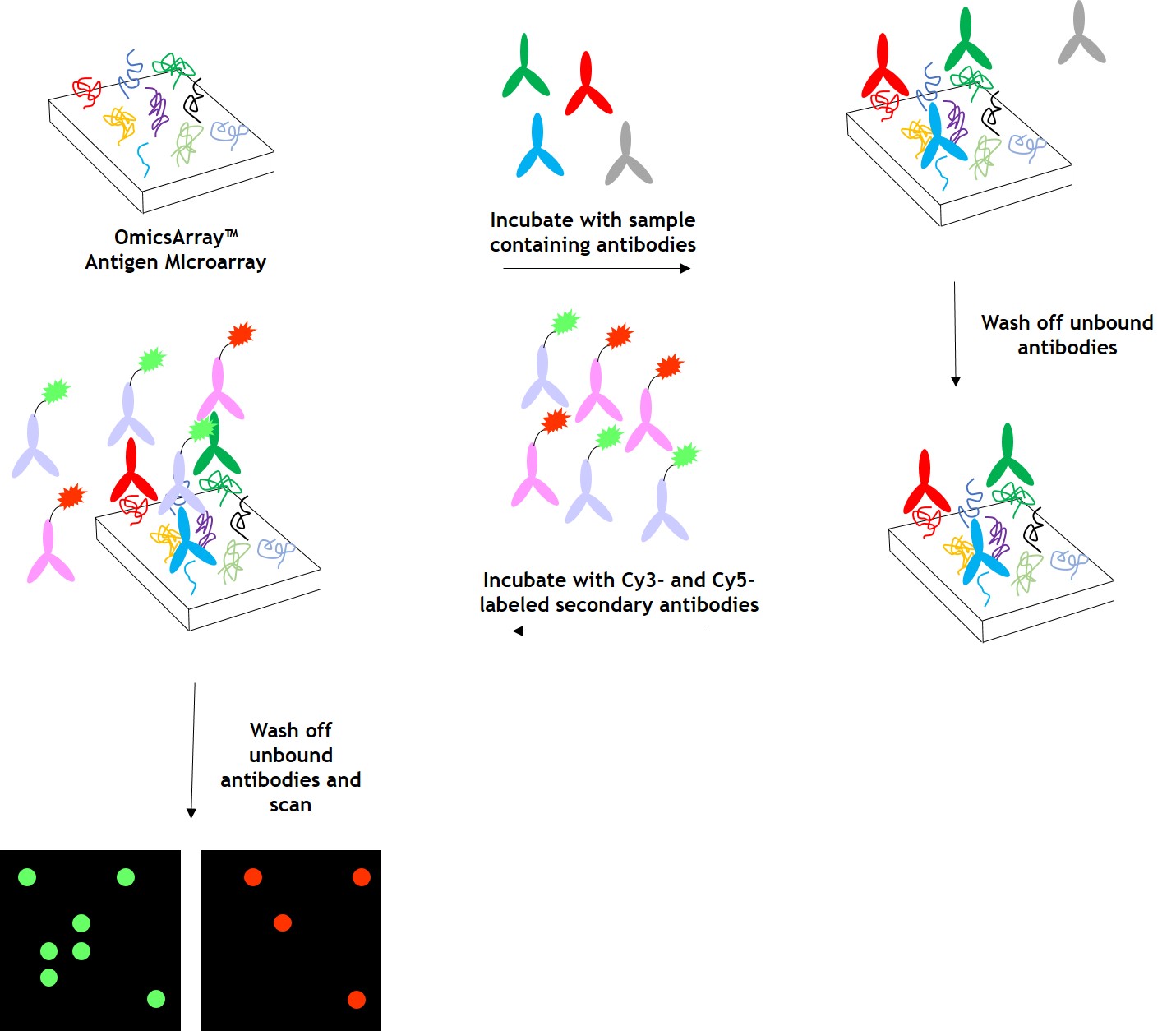
GeneCopoeia’s OmicsArray™ antigen microarrays are high-throughput protein microarrays (also known as “protein arrays” or “protein chips”) that are powerful tools for many applications, including autoantibody profiling, biomarker detection, pathogen-specific antibody identification, and more. Antigen microarrays enable the detection of hundreds to thousands of antibodies or other biomarkers present in multiple samples in parallel.
Each array contains superior-quality purified antigens printed onto nitrocellulose filters, which are adhered to glass slides. Antigens known to be associated with specific diseases or pathogens are chosen based on a thorough review of peer-reviewed publications.
Figure 1. Workflow for autoantibody profiling in samples using GeneCopoeia’s OmicsArray™ antigen microarrays.
Advantages of OmicsArray™ Antigen Microarrays
- Largest collection of pre-made whole-protein antigen microarrays on the market.
- Largest number of whole-protein antigens specifically focused on autoimmune disease research.
- Best combination of number of antigens per array (up to 120) with number of samples that can be processed per slide (up to 15).
Resources
Learn more about GeneCopoeia’s antigen microarray.
 Powered by Bioz
CRISPRa/i Stable Cell Lines
GeneHero™ CRISPRa Stable Cell Lines
GeneHero™ CRISPRa Stable Cell Lines are mammalian cell lines stably expressing synergistic activation mediators (SAM) for the study of transcriptional activation of endogenous genes. These CRISPRa cell lines have stably integrated human codon-optimized dCas9 fused at the C-terminus of transcriptional activator VP64, and activation helper protein complex MPH (MS2-p65-HSF1).GeneHero™ CRISPRi Stable Cell Lines
GeneHero™ CRISPRi Stable Cell Lines are mammalian cell lines stably expressing dCas9-KRAB fusion protein for the study of transcriptional inhibition of endogenous genes. These CRISPRi cell lines have stably integrated human codon-optimized dCas9 fused to a transcriptional repressor peptide KRAB to silence target gene expression.CAR-T Target Luciferase-labeled Cancer Cell Lines
Chimeric antigen receptor (CAR)-T cells have displayed remarkable efficacy in treating malignant cancers, particularly liquid tumors. CAR-T cell therapy treats cancer by modifying T cells so that they can recognise and effectively destroy cancer cells. The standard approach is to harvest T cells from the patient, genetically modify them, and then inject the resulting CAR-T cells into the patient to attack their tumour. Scientists are currently working intensively to develop different CAR constructs to broaden the range of cancer types targeted and improve their anti-tumour efficacy. The luciferase-labeled CAR-T target cancer cell line can be used as a target cancer cell for in vitro killing assays by CAR-T cells. The luciferase-mediated bioluminescence imaging (BLI) assay is one of the most commonly used assays to investigate cell-mediated cytotoxicity. The cytotoxicity of effector cells can be quantified by measuring the decrease in the BLI signal. In addition to the simplicity of the BLI assay, the use of luciferase-labeled target cells enhances inter-assay reproducibility. The utilisation of these stable cell lines in cytotoxicity and cell viability assays facilitates real-time monitoring of the potency and efficacy of candidate CAR-T effector cells, driving breakthroughs in immunotherapy.Order Information
Raji-Luc
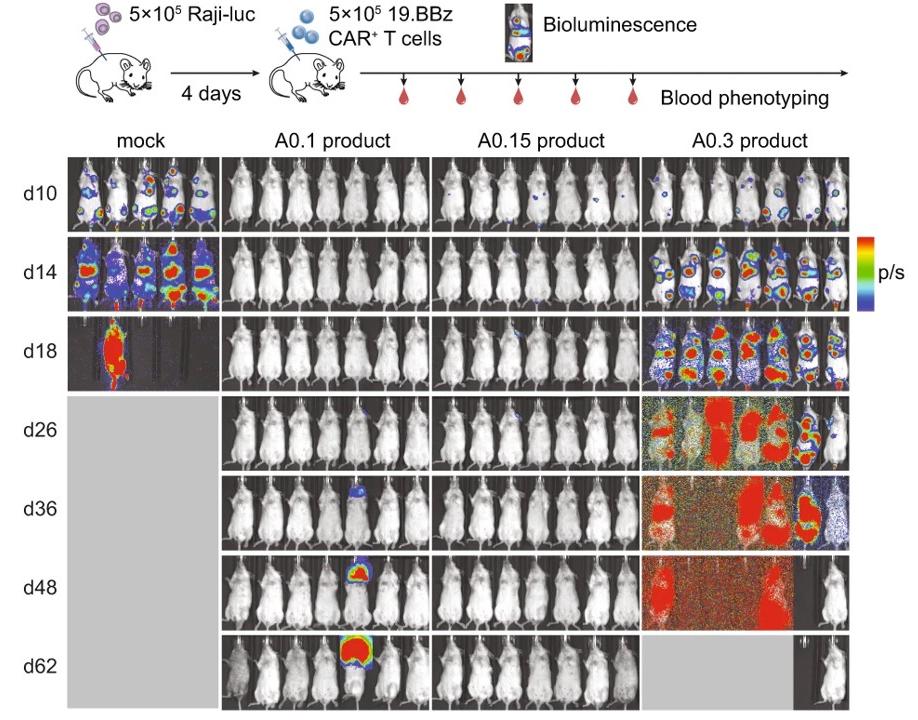 Ref. Zhang, D.K.Y., Adu-Berchie, K., Iyer, S. et al. Enhancing CAR-T cell functionality in a patient-specific manner. Nat Commun 14, 506 (2023).
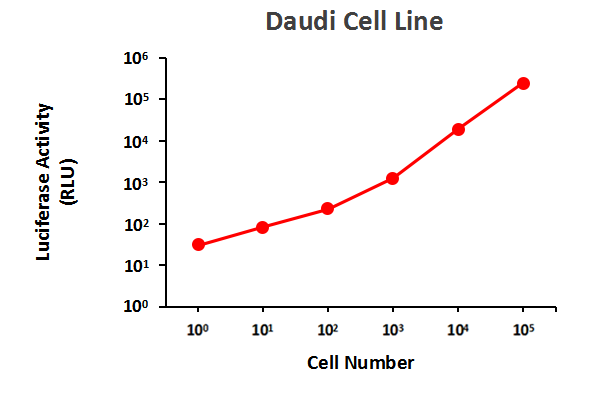
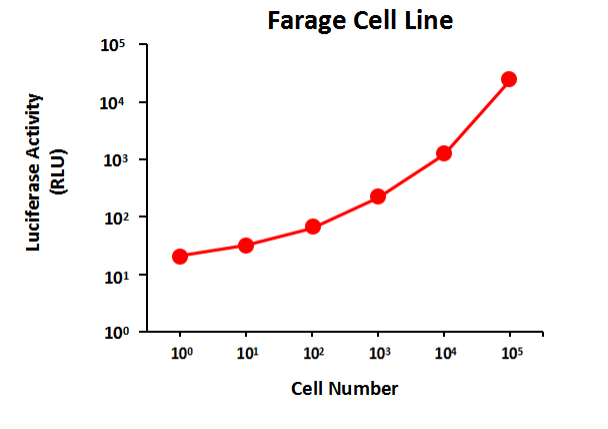
 Serial dilutions of Raji-Luc cells were plated into a 96 well plate (white well). The luciferase activity was tested using GeneCopoeia™ Luc-Pair™ Firefly Luciferase HS Assay Kit (Cat. No. LF007). High expression of Luciferase activity was detected in this cell line.
CAR-T target luciferase-labeled Raji cell line
Established from tumour cells of a Burkitt’s lymphoma patient, Raji cells constitutively express the B-cell antigens CD19, CD20, and CD22 and can be used to evaluate cancer-targeted immunotherapies such as CAR-T cells. The luciferase-labeled Raji cancer cell line was modified from the Raji wild-type cell line to express firefly luciferase stably. Raji-Luc cell line did not differ significantly from the wild-type cells in appearance, and trended similarly to the wild-type Raji cell line in terms of tumourigenicity. High expression of luciferase activity was detected in this cell line. Raji-Luc cell line is an excellent target for CAR-T or NK cells targeting CD19, CD20 or CD22. The luciferase reporter gene produces a signal that is proportional to the number of Raji cells, helping to quantify how well it kills Raji cells when co-cultured with CAR-T or NK cells.Case study
The luciferase-labeled Raji cancer cell line naturally expresses high levels of CD19, which can be used as a target cancer cell for an in vitro killing assay by CD19 CAR-T cells and is expected to also work for CD20 CAR-T cells. Zhang, D.K.Y. et al. tested the efficacy of three CAR-T cell products using CD19-expressing Raji-luc cells in a disseminated xenograft model of Burkitt’s lymphoma. The level of fluorescence intensity of Raji-luc cells in vivo reflects the proliferation and distribution of tumour cells in the animal.
Ref. Zhang, D.K.Y., Adu-Berchie, K., Iyer, S. et al. Enhancing CAR-T cell functionality in a patient-specific manner. Nat Commun 14, 506 (2023).
Performance data
Serial dilutions of Raji-Luc cells were plated into a 96 well plate (white well). The luciferase activity was tested using GeneCopoeia™ Luc-Pair™ Firefly Luciferase HS Assay Kit (Cat. No. LF007). High expression of Luciferase activity was detected in this cell line.
RNA Synthesis In vitro Transcription (IVT)
In vitro RNA synthesis refers to the synthesis of RNA from a DNA template using a phage DNA-dependent RNA polymerase (e.g., T7, T3, or SP6 RNA polymerase). Template DNA for in vitro transcription (IVT) includes the RNA polymerase promoter upstream of the target sequence, and template options include plasmids, PCR products, oligonucleotides, and linearised DNA templates such as cDNA that contain the corresponding promoter. In vitro transcripts are used in analytical techniques (e.g., hybridization analysis), structural studies (for NMR and X-ray crystallography), in biochemical and genetic studies (e.g., as antisense reagents), and as functional molecules (ribozymes and aptamers). IVT products include RNA synthesis systems, nuclear extracts, ribonucleotides, cloning vectors and supporting products for transcription, primer extension and gene expression studies.T7 RNA Polymerase
T7 RNA Polymerase is a DNA-dependent RNA polymerase with strict specificity for T7 promoter. Use double-stranded DNA (linearised plasmid or PCR product) as a template to synthesise RNA that is complementary to the reverse single-stranded DNA downstream of the promoter. T7 RNA Polymerase accepts modified nucleotides (e.g., biotin-, digoxigenin-, fluorescein-labeled nucleotides) as substrates for RNA synthesis.DNase I
DNase I is an endonuclease that digests single- and double-stranded DNA. It hydrolyzes phosphodiester bonds producing mono- and oligodeoxyribonucleotides with 5’-phosphate and 3’-OH groups. The enzyme activity is strictly dependent on Ca2+ and is activated by Mg2+ or Mn2+ ions. If in the presence of Mg2+, DNase I cleaves each strand of dsDNA independently, in a statistically random fashion. If in the presence of Mn2+, the enzyme cleaves both DNA strands at approximately the same site, producing DNA fragments with blunt-ends or with one or two nucleotide overhangs.Poly(A) Polymerase
Poly(A) Polymerase (PAP) catalyzes the incorporation of adenine residues into the 3’-termini of various kinds of polyribonucleotides. PAP can utilize various kinds of single-stranded RNAs as substrates but not DNA. Double-stranded RNA and excessively short oligonucleotides are not recommended as substrates. ADP and dATP cannot be used as substrates. The incorporation of CTP and UTP is less than 5% of that of ATP, and the enzyme cannot incorporate GTP into the 3’-termini of polyribonucleotides.T7 RNA Synthesis Kit
T7 RNA Synthesis Kit is designed for in vitro transcription of large amounts of RNA, provides with T7 RNA polymerase mix and four individually available nucleotides. The kit can also be used to synthesize capped RNA by adding cap analog; or to synthesize modified RNA by replacing with modified UTP according to experimental requirements. The kit contains LiCl Solution for removing free nucleotides, enzymes and most of the template from the transcription product to obtain coarsely purified RNA.T7 Co-transcription RNA Synthesis Kit
The T7 Co-transcription RNA Synthesis Kit is designed for in vitro transcription of large amounts of capped RNA, provides with T7 RNA polymerase mix, Cap Analog and four individually available nucleotides. The kit can also be used to synthesize capped RNA by adding cap analog; or to synthesize modified RNA by replacing with modified UTP according to experimental requirements. The kit synthesizes long transcripts or short transcripts by co-transcription. 1 μg of template input can produce approximately 80 μg of capped RNA.In-vitro Transcription Workflow

| Template Generation | in vitro Transcription | RNA Purification | ||
| PCR & Purification | Cloning & Plasmid Production | RNA Synthesis | Capped RNA Synthesis | |
Taq DNA Polymerase Kit
(#PC003) |
OmicsLink™ Expression-Ready ORF cDNA Clones | T7 RNA Polymerase
(#PC028 / PC029) |
DNase I
(#PC024) |
|
2× UltraHiPF® PCR Mix
(#PC033 / PC034) |
Fast-Fusion™ Cloning Kit
(#FF001 / FF002) |
T7 RNA Synthesis Kit
(#PC035 / PC036) |
T7 Co-Transcription RNA Synthesis Kit
(#PC045 / PC046) |
|
UltraHiPF® DNA Polymerase Kit
(#PC018 / PC019) |
Fast-Fusion™ Multi Seamless Cloning Kit
(#FF006 / FF007) |
ATP / CTP / GTP / UTP / N1-Me-pUTP Solution
(#PC037 / PC038 / PC039 / PC040 / PC041) |
||
DH5α/Stbl3/2T1 Competent Cells
(#CC001 / CC003 / CC007) |
Poly(A) Polymerase
(#PC051 / PC052) |
|||