by Ed Davis | Jul 31, 2017 | Products
Introduction
Using a secreted and robust Gaussia Luciferase (GLuc) as the reporter, GeneCopoeia GLuc-ON™ promoter clones are designed for promoter analysis by detecting the real-time activities of about 39,500 human, 28,700 mouse and 17,500 rat promoters using live cell assays.GLuc-ON promoter clones can be ordered as pre-designed or custom-built in one of our robust vector systems. Currently, we offer both single-reporter and dual-reporter vector systems. The single-reporter system uses GLuc, mCherry, or GFP as the promoter reporter. The dual-reporter system uses GLuc as the promoter reporter and SEAP (secreted Alkaline Phosphatase) as the internal control for signal normalization. GLuc and SEAP-containing promoter-reporter clones are fully compatible with GeneCopoeia’s Secrete-Pair™ dual luminescence assays kits.
Advantages
- Live cell assays. Naturally secreted GLuc and SEAP reporters make lysis of the cells unnecessary. Reduces the number of samples required and sample-to-sample variation for applications such as pulse chase analysis and time courses.
- Dual secreted reporter system. SEAP enables transfection normalization for accurate across-sample comparison
- High sensitivity. GLuc is 1,000-fold more sensitive than firefly and Renilla luciferases
- Convenience. All promoter clones are transfection-ready
Order pre-designed promoter clones
To order pre-designed promoter clones, search almost 40,000 human, 30,000 mouse, and 18,000 rat clones in your choice of vector.

Custom promoter clone services
Don’t see what you need in our collection of pre-designed promoter clones? Contact us for our custom services. Please complete our Custom Promoter Clone Inquiry and Quotation form, email inquiry@genecopoeia.com, or call: 866-360-9531.

Promoter lentivirus
GeneCopoeia also offers ready-to-use lentiviral particles expressing promoter-reporters as a custom service.

Vector choices
GLuc-ON™ promoter-reporter clones are available in a variety of vector types, which enable you to choose either the type of reporter, (GLuc, eGFP, etc.), whether or not you want a tracking gene for normalization, selection marker, and non-viral or lentiviral. Refer to the table below to discover the distinguishing features of Gluc-ON™ promoter-reporter vectors.
| Vector |
Reporter gene |
Tracking gene |
Selection marker |
Vector type |
| pEZX-PG04** |
Gaussia luciferase (GLuc) |
Secreted alkaline phosphatase (SEAP) |
Puromycin |
Non-viral |
| pEZX-PG02** |
Gaussia luciferase (GLuc) |
N/A* |
Puromycin |
Non-viral |
| pEZX-PF02 |
eGFP |
N/A* |
Puromycin |
Non-viral |
| pEZX-PM02 |
mCherry |
N/A* |
Puromycin |
Non-viral |
| pEZX-LvPG04** |
Gaussia luciferase (GLuc) |
Secreted alkaline phosphatase (SEAP) |
Puromycin |
HIV Lentiviral |
| pEZX-LvPG02** |
Gaussia luciferase (GLuc) |
N/A* |
Puromycin |
HIV Lentiviral |
| pEZX-LvPF02 |
eGFP |
N/A* |
Puromycin |
HIV Lentiviral |
| pEZX-LvPM02 |
mCherry |
N/A* |
Puromycin |
HIV Lentiviral |
| pEZX-LvPM03 |
tdTomato |
N/A* |
Puromycin |
HIV Lentiviral |
* A separate vector is available for SEAP expression.
** These Gaussia luciferase cloning vectors are available for purchase.
Control clones and SEAP expression clone
For most experiments with promoter-reporter clones, GeneCopoeia recommends including both positive and negative controls. See below to choose from a larger number of control clones. You can also purchase an SEAP expression clone, to normalize signals for differences in transfection efficiency for single reporter vectors.
How it works
Each transfection-ready promoter clone contains a 1.2-1.5 kb insert, corresponding to the 5′-flanking promoter sequence located approximately 1.5 kb upstream and up to 200 bp downstream of the transcription start site (TSS) of a specific human gene. This insert is placed upstream of the GLuc reporter gene. Since the putative cis-acting enhancer elements are expected to exist in the cloned promoter region, the promoter luciferase activity observed during the reporter assay closely resembles the actual promoter regulation of these genes within human cells.
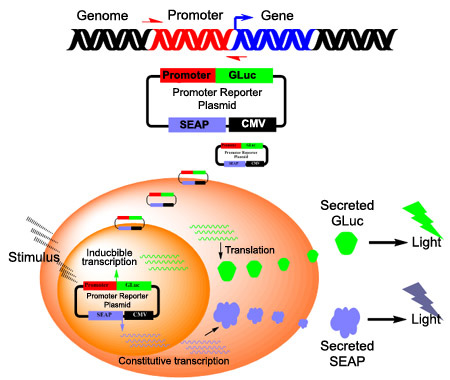
Figure 1. How GLuc-ON promoter clones work.Gaussia luciferase
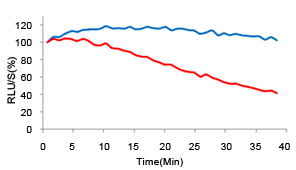
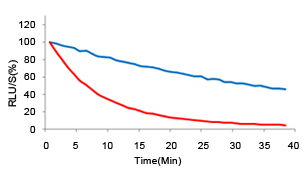
GLuc-ON promoter clones use a modified GLuc (mGLuc) as the reporter gene, which generates a highly stable signal and overcomes the quick signal decay commonly observed with humanized wild type GLuc (wtGLuc).
Figure 2. Signal stability of mGLuc (blue) and wtGLuc (red). Left: assay buffer with a stabilizer; Right: regular assay buffer (Secrete-Pair™ dual luminescence assay kit)
Dual-reporter system
Dual-reporter vectors are available for the GLuc-ON promoter clones. The secondary reporter, secreted Alkaline Phosphatase (SEAP), serves as an internal control. The dual-reporter system enables transfection normalization for accurate cross-sample comparison.
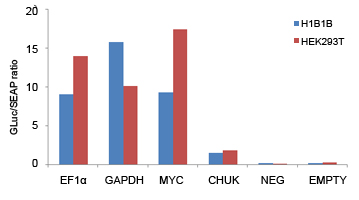
Figure 3. Normalized promoter activities in H1B1B and HEK293T cells. Dual-reporter promoter clones or controls were transfected into two cell lines in duplicates. Samples were analyzed 24 hrs (HEK293T) and 48 hrs (H1B1B) after transfection. NEG (containing non-promoter sequence) and EMPTY (no promoter in the vector) are negative controls.
Related Products
Related products
by Ed Davis | Jul 28, 2017 | FAQs, FAQs-SubPage
- Genome editing products (Genome-TALER™ TALEN and TALE-TF custom services, Genome-CRISP™ CRISPR-Cas9 products and services, Human AAVS1 safe harbor gene targeting kits and clones)
- Lentivirus (Lentifect™ Standard and Purified Lentivirus, Lenti-Pac™ Lentiviral Packaging Systems, lentiviral clones)
by Ed Davis | Jul 28, 2017 | FAQs, FAQs-SubPage
Luciferase Assays
Answer: To visualize Firefly and Renilla luciferase activity, it is necessary to first lyse the cells. On the other hand, GeneCopoeia’s Secrete-Pair™ Dual Luminescence Assay system uses two secreted reporters: Gaussia luciferase (GLuc) and secreted alkaline phosphatase (SEAP). Secreted reporters can be detected in the cell medium without lysing the cells. Therefore, you can assay the same sample multiple times, which is provides greater accuracy and reproducibility than assaying multiple samples in applications such as time course assays.
Answer: “RLU” stands for “Relative Light Unit”. Luminometers do not measure light output, in terms of numbers of photons, directly.
Answer: All GeneCopoeia luciferase kits are compatible with all known luminometers.
Answer: All GeneCopoeia luciferase reagents are stable for at least 6 months if stored at -20°C.
Answer: To prevent loss of activity, it is best to avoid repeated freezing and thawing. We recommend pipetting small aliquots into new, clean, sterile tubes and placing those aliquots at -20°C. Once you have thawed one of the aliquots, discard it instead of putting it back in the freezer.
Answer: The Gaussia luciferase substrate, coelenterazine, is also the substrate for Renilla luciferase, so it is compatible with Renilla. However, coelenterazine cannot be used with Firefly (Photinus pyralis) luciferase, which instead uses luciferin as its substrate.
Answer: Unfortunately, the individual components of GeneCopoeia's luciferase kits cannot be purchased separately at this time.
Answer: Typically, between 12 and 24 hours.
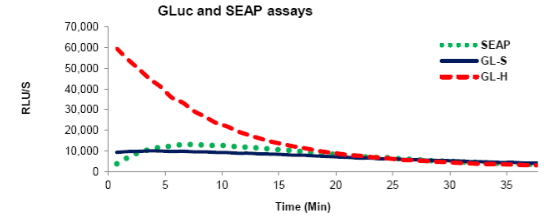
Answer: Buffer GL-S, which provides greater signal stability, is most useful when assaying a relatively large number of samples. Its enhanced signal stability means that there will be little sample-to-sample variation due to signal decay. Buffer GL-H is used when maximal signal intensity is required, but the trade-off is that the signal decays more rapidly under typical laboratory conditions. Buffer GL-H is not appropriate for measuring the activities of large numbers of samples, unless sample injectors are used.
Answer: The
Luc-Pair™ Duo-Luciferase Assay Kit 2.0 (For Enhanced Stability),
Luc-Pair™ Duo-Luciferase Assay Kit HT (For High Throughput),
Luc-Pair™ Firefly Luciferase HT Assay Kit, and
Luc-Pair™ Renilla Luciferase HT Assay Kit (For High Throughput), which provide greater signal stability, are most useful when assaying a relatively large number of samples. Their enhanced signal stability means that there will be little sample-to-sample variation due to signal decay. Conversely, the
Luc-Pair™ Duo-Luciferase HS Assay Kit (For High Sensitivity),
Luc-Pair™ Firefly Luciferase HS Assay Kit (For High Sensitivity), and
Luc-Pair™ Renilla Luciferase HS Assay Kit (For High Sensitivity) are used when maximal signal intensity is required, but the trade-off is that the signal decays more rapidly under typical laboratory conditions. These kits are not appropriate for measuring the activities of large numbers of samples, unless sample injectors are used.
by admin | Jul 19, 2017 | landing
– Gaussia Luciferase (GLuc) and Secreted Alkaline Phosphatase (SEAP) dual-reporter system
- Secreted reporters enable live cell analysis. Ideal for time point studies and high-throughput screening.
- SEAP allows normalization for greater accuracy.
- Compatible with GeneCopoeia’s promoter clones, miRNA target clones, & cloning vectors.
- Gaussia luciferase reporter vectors – Only $49 each when purchased together with Secrete-Pair™ Luciferase Assay Kits*.
– Firefly & Renilla systems
- Firefly & Renilla systems
- Compatible with GeneCopoeia, Promega and many other luciferase cloning system
- A wide variety of choices for your research needs
by admin | Jul 17, 2017 | landing
 |
Pre-made CRISPR-Cas9 Stable Cell Lines
– Largest Collection On The Market
- Stable Cas9 integration eliminates need for the sgRNAs co-transfection. Ideal for high-throughput applications.
- Single clone isolation provides robust Cas9 expression in a uniform background.
- Cas9 functionally validated using the IndelCheck™ T7 Endonuclease I assay.
- Available for human, mouse and rat
|
- Applications include:
- CRISPR sgRNA or TALEN functional validation
- Screening cell clones for knockout (KO) and knock-in (KI) modifications
- Fast turnaround
- For human, mouse and rat
- $60/ Cas-9 clone; $149/ sgRNA clone


 Powered by Bioz