Select Page

GeneHero™ TALEN and TAL Effector Products and Services

Site-specific genome editing at will

Introduction
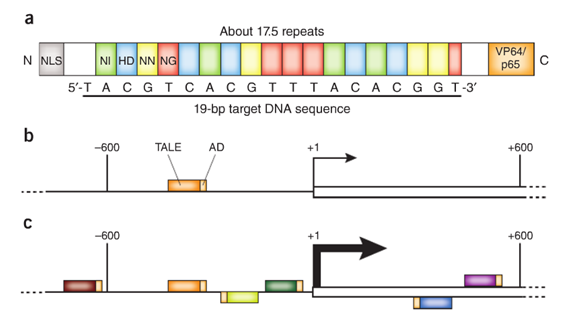
Transcription activator-like (TAL) effectors are DNA binding proteins produced by Xanthomonas bacteria when they infect plants. These proteins can activate the expression of plant genes by recognizing and binding host plant promoter sequences through a central repeat domain consisting of a variable number of ~34 amino acid repeats. The residues at the 12th and 13th positions of each repeat are hyper-variable. There appears to be a simple one-to-one code between these two critical amino acids in each repeat and each DNA base in the target sequence, e.g., NI = A, HD = C, NG = T, and NN = G or A.
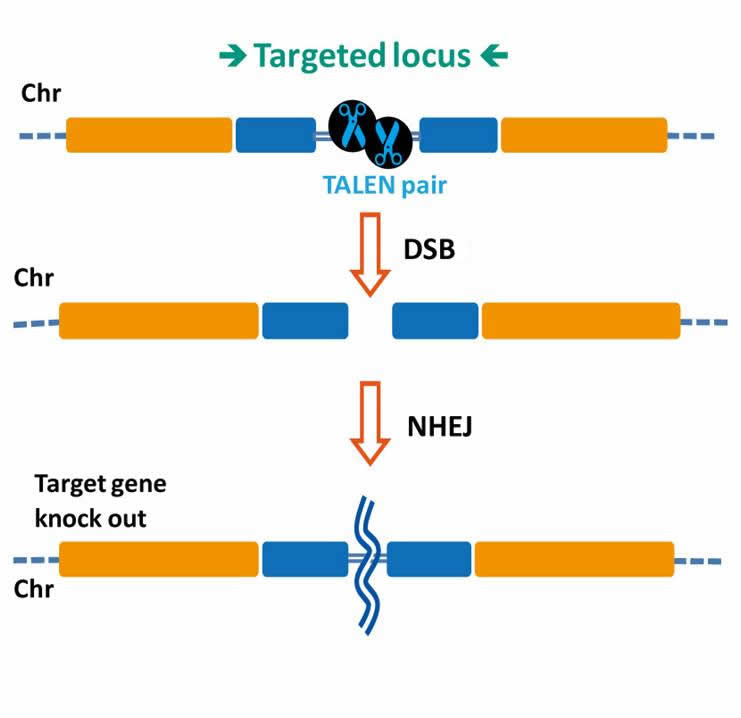
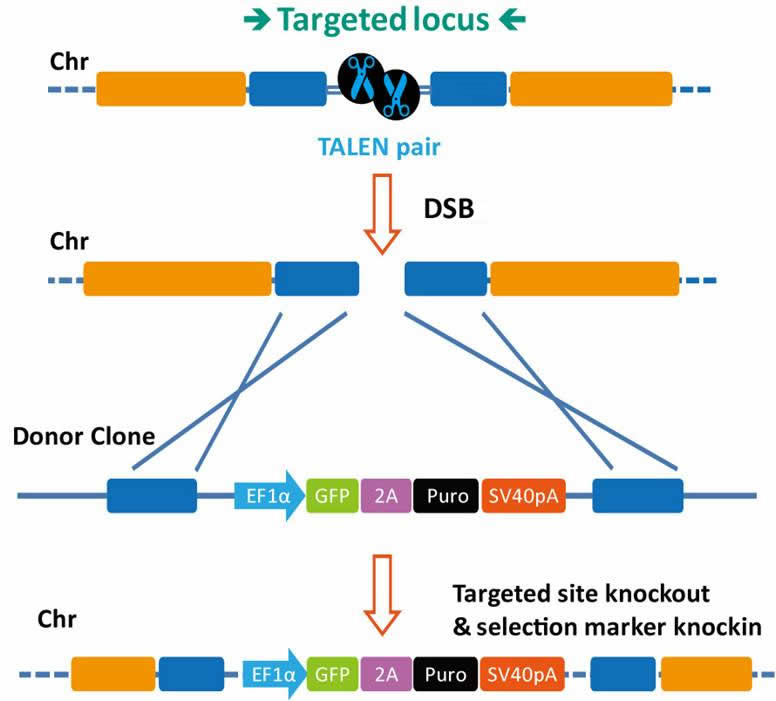
TAL effectors have been utilized to create site-specific gene-editing tools by fusing target sequence-specific TAL effectors to nucleases (TALENs), transcription factors (TALE-TFs), and other functional domains. These fusion proteins can recognize and bind chromosome target sequences specifically to execute their gene editing functions, such as gene knockout, knockin (with donor plasmid), mutagenesis, activation, repression, and more. Unlike zinc fingers’ nucleotide triplet recognition, TAL effector domains recognize single nucleotides, which allows researchers to be able to specifically target whatever sequence they want.
Advantages
  • Target any sequence in any cell
  • Highly sequence-specific genome editing
  • For gene knockout, knockin, mutagenesis, activation, repression and more
  • Flexible TAL effector design of binding and functional domains, such as TALEN and TALE-TF
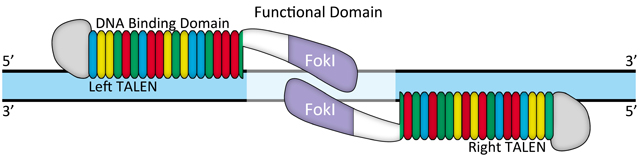
Figure 1. Illustration of TALEN design
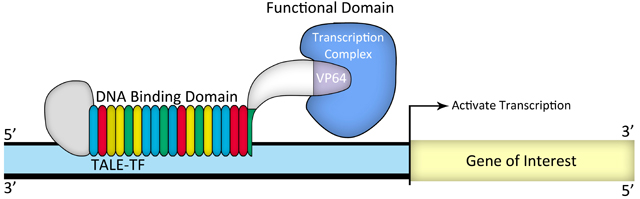
Figure 2. Illustration of TALE-TF design


Comparison between TALEN and CRISPR-Cas9 Systems

Property TALEN CRISPR-Cas9
Type of recognition Protein-DNA RNA-DNA
Methylation sensitive Sensitive Not sensitive
Chromotin structure sensitive Sensitive Sensitive
Off-target effect Less observed off-target effects More potential off-target effects than TALENs and ZFNs
Multiplexing Rarely used Capable
 

References

  1. Boch, J. et al. Breaking the code of DNA binding specificity of TAL-type III effectors. Science. 2009 326(5959):1509-12
  2. Moscou, M. et al. A simple cipher governs DNA recognition by TAL effectors. Science. 2009 326(5959):1501
  3. Christian, M. et al. Targeting DNA Double-Strand Breaks with TAL Effector Nucleases. DOI: 10.1534/genetics.110.120717
  4. Morbitzera, R. et al. Regulation of selected genome loci using de novo-engineered transcription activator-like effector (TALE)-type transcription factors. www.pnas.org/cgi/doi/10.1073/pnas.1013133107
  5. Cermak, T. et al. Efficient design and assembly of custom TALEN and other TAL effector-based constructs for DNA targeting. Nucleic Acids Research, 2011, Vol. 39, No. 12   e82 doi:10.1093/nar/gkr218
  6. Li, T. et al. Modularly assembled designer TAL effector nucleases for targeted gene knockout and gene replacement in eukaryotes. Nucleic Acids Research, 2011, Vol. 39, No. 14   6315–6325 doi:10.1093/nar/gkr188
  7. Zhang, F. et al. Programmable Sequence-Specific Transcriptional Regulation of Mammalian Genome Using Designer TAL Effectors. Nat Biotechnol. 2011 February ; 29(2): 149–153. doi:10.1038/nbt.1775.
Popular product areas and services-for front page

Clone collections

ORF cDNA, CRISPR, shRNA, miRNA, promoter, TRE, and more


Antigen microarrays

Predesigned antigen arrays and custom screening services

Genome editing

CRISPR, indel detection, donors, cell lines, mouse lines, Safe Harbor, FISH, TALEN


microRNA solutions

qPCR arrays and primers, qPCR kits, 3’UTR clones, precursor clones, inhibitor clones

Viral delivery systems

Lentiviral and AAV Systems


qPCR products

Arrays, primers, RT-PCR kits

Cell line products and services

Premade CRISPR and cancer-related stable cell lines, custom cell line services for ORF, CRISPR, shRNA and more


Reagents and kits

Luciferase kits, transfection reagents, cloning system, FISH probes, and more


Lentivirus solutions

GeneCopoeia offers multiple lentiviral tools for over-expression or knockdown of your gene or microRNA of interest. With the option to buy the tools for producing lentivirus or buy pre-made lentivirus, GeneCopoeia collection of lentiviral tools seek to address your lentiviral research needs.
Lentiviral clones, kits and reagents

Express

  • ORF cDNA: Express your protein with ready-to-express ORF clones in more than 40 lentiviral vectors with various fusion tags
  • shRNA: Knockdown your target genes with shRNA clones available in lentiviral vectors with eGFP or mCherry fusion tags
  • Precursor miRNA: Over-express miRNA with precursor miRNA clones available in lentiviral vectors with eGFP reporter gene
  • miRNA inhibitors: Knockdown your miRNA of interest using lentiviral vector-based miRNA inhibitor clones

Package

Concentrate

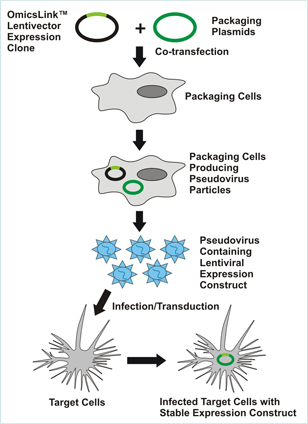
Lentivirus generation

Figure 1. Lentivirus generation

Ready made lentivirus

Pre-made Lentivirus

  • Available for iPSC genes, luciferases, fluorescent genes, positive and negative control, many more
  • Both Standard and purified options available

Special collection lentivirus service

  • A low price and fast delivery service
  • Offered for genome-wide human ORF cDNA and all known human, mouse and rat miRNA and miRNA inhibitors

Custom lentivirus service

  • Available for any construct including ORF cDNA, shRNA, precursor miRNA and miRNA inhibitors
  • Choice of 100s of expression vectors and fusion tags

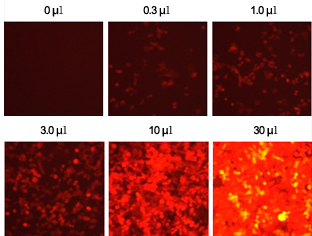
Figure 2. H1299 cells (ATCC) in 24-well plates were transduced with the indicated amounts of Standard mCherry lentiviral particles, catalog number LP-MCHR-LV105 in the presence of 5 µg/ml of polybrene. The expression of eGFP was checked with a fluorescence microscope 72d hours post-transduction.

Publication highlights

Kraskiewicz, H. et al. (2011) Partial XBP1 knockdown does not affect viability of oligodendrocyte precursor cells exposed to new models of hypoxia and ischemia in vitro. Journal of Neuroscience Research 5 (89): 661-673 [rat XBP1 shRNA lentivirus

Nikkhah, M. et al. (2011) MCF10A and MDA-MB-231 human breast basal epithelial cell co-culture in silicon micro-arrays. Biomaterials 30 (32):7625-7632 [mCherry lentivirus]

Zheng, L. et al. (2011) Tyrosine 23 Phosphorylation-Dependent Cell-Surface Localization of Annexin A2 Is Required for Invasion and Metastases of Pancreatic Cancer. PLoS ONE 4 (6) [mouse ANXA2 shRNA Lentivirus]

Have Questions?

Contact inquiry@genecopoeia.com for more information or
call 301-762-0888

Protein Subcellular Localization & Validated Organelle Markers

The study of protein subcellular localization is necessary to elucidate protein function. To facilitate protein localization studies inside cells, organelles and tissues, GeneCopoeia offers multiple sets of expression-ready ORF cDNA constructs. These constructs consist of full-length mouse and human cDNA ORFs fused with various tags including eGFP, mCherry, SNAP-Tag™ and HaloTag®.
Fully-sequenced, expression-ready GeneCopoeia ORF cDNA tagged plasmids enable many studies including:
  • Subcellular protein localization in live and fixed cells
  • Monitoring of multiple proteins trafficking in one assay
  • Protein detection, tracking and characterization
  • Organelle morphology without antibodies
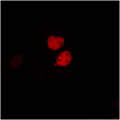
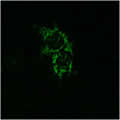
  • Co-localization (see figure 1)

Co-localization of two proteins in the same cell using OmicsLink™ ORF expression clones

1 2 3 4 5
Figure 1. TOMM20 (translocase of outer mitochondrial membrane 20 homolog) is located in the mitochondria. LEF1 (Lymphoid enhancer-binding factor 1) is located in the nucleus. Using standard cell and transfection techniques, cells were co-transfected with two plasmids; EX-G0283-M26 (encoding the TOMM20 gene fused with SNAP-Tag™ ) and EX-W0594-M50 (encoding the LEF1 gene fused with HaloTag®). Twenty-four hours after transfection, the cells were labeled with HaloTag® TMR ligand and SNAP Cell BG505 ligand according to the manufacturer’s instructions. The nuclei were stained with DAPI and the subcellular structures of the cells were imaged using fluorescent microscopy: (1) cells labeled with Halo-TMA ligand (red); (2) cells labeled with SNAP Cell BG505 ligand (green); (3) overlay of 1 and 2; (4) cells stained with DAPI; and (5) overlay of 1, 2 and 4.

Validated organelle markers and predicted subcellular localization genes

Click on each organelle name for gene list or Browse all validated organelle markers and predicted subcellular localization genes.
 

Human full-length ORF expression clones for studying protein localization

Vector Promoter Host Cell Selection
Marker
Tag Protease
Site
pReceiver-M97 EF1a Mammalian Neomycin C-eGFP(monomeric) N/A
pReceiver-M37 CAG Mammalian Neomycin C-eGFP N/A
pReceiver-M29 CMV Mammalian Neomycin N-eGFP N/A
pReceiver-M98 CMV Mammalian Neomycin C-eGFP(monomeric) N/A
pReceiver-M03 CMV Mammalian Neomycin C-eGFP N/A
pReceiver-M15 CMV Mammalian Neomycin N-eYFP N/A
pReceiver-M16 CMV Mammalian Neomycin C-eYFP N/A
pReceiver-M49 CMV Mammalian Neomycin N-HaloTag Tev protease
pReceiver-M50 CMV Mammalian Neomycin C-HaloTag Tev protease
pReceiver-M55 CMV Mammalian Neomycin N-mCherry N/A
pReceiver-M56 CMV Mammalian Neomycin C-mCherry N/A
 

Warranty Statements and End-user License Agreements

cDNA clones

miRNA

Promoter Reporter

shRNA

Lentivirus

Adeno-associated Virus

Custom gene synthesis

qPCR

TALEN

CRISPR-Cas9

Safe Harbor

Cloning vectors

Stable cell lines