Recombinant Protein Expression |
RTS 500 Wheat Germ CECF Kit
ApplicationThe RTS Wheat Germ product line combines several new technologies for efficient and optimized protein expression using a eukaryotic cell lysate. It overcomes limitations that often restrict the use of E. coli-based systems, especially in the production of eukaryotic target proteins.The RTS 500 Wheat Germ CECF Kit enables high success rates for expression and solubility, particularly for eukaryotic target proteins. Convenience is greatly improved, due to the ability to use PCR-generated linear templates; plasmids and mRNA can also be used as template. Use this kit to synthesize proteins in a wide molecular weight range (up to 220 kD, as tested) as well as to synthesize truncated protein variants (e.g., for epitope or functional domain mapping). Benefits
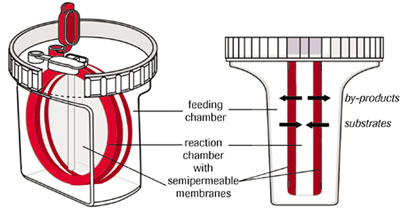
Product DescriptionIn contrast to traditional eukaryotic in vitro transcription/translation reactions, which run for only 4 hours in batch mode, the RTS Wheat Germ system is the only eukaryotic protein synthesis system that uses the continuous-exchange, cell-free (CECF) technology. This CECF system prolongs the reaction for at least 24 hours and increases the yield dramatically. In the RTS 500 Wheat Germ CECF Kit, transcription and translation take place simultaneously in the 1 ml reaction compartment of the reaction device. Substrates and energy components needed for a sustained reaction are continuously supplied via two semipermeable membranes. At the same time, potentially inhibitory reaction by-products are diluted via diffusion through the same membranes into the 10 ml feeding chamber (Figure 1).
Background InformationGene expression in the RTS 500 Wheat Germ CECF system can be initiated either by utilizing linear templates generated through PCR using the RTS Wheat Germ Linear Template Generation Set, His6-tag, or via standard cloning using the RTS pIVEX Wheat Germ His6-tag Vector Set. mRNA obtained by in vitro transcription can also be used for protein expression (see the pack insert of the RTS 500 Wheat Germ CECF Kit).Common limitations of RTS Wheat Germ lysates: The RTS Wheat Germ system (in the absence of further modification) cannot perform the following post-translational modifications of the expressed proteins:
The RTS 500 Wheat Germ CECF Kit requires the use of the RTS ProteoMaster Instrument or the Eppendorf Thermomixer in combination with the RTS 500 Adapter! ContentsEach kit contains enough reagents for 5 coupled transcription-translation or translation-only reactions of 1 ml.
Typical Experiment
Order ProductsVisit Manufacturer’s Website for More Information: |